Monday, April 4, 2016

Steam/Dieselpunk Pictures


This is the mothership aircraft that carry the parasite fighter in his tail. Here is the moment of the release by a cable. The cable can be hooked once more by the pilot in the same fashion as the refuelling probe of our fighters today. The cable can be extended well behind the mothership.

The steam turbines are placed in the wing tips in order to do not disturb the recovery operations with turbulences and steam trails.


Power source are boilers that burn a powerful mixture of synthetic chemicals, and there is several large water tanks inside de fuselage.


The mothership is protected by the parasite fighter and by his own guns in remotely-controlled turrets
.

Steam-powered mothership by CUTANGUS

Crimson Skies!


The Introduction to one of my most favorite games of all time, Crimson Skies! This is the PC version, which was had way more of a Sim feel to it then the Xbox. However, both are great games and I recommend them heartily.

The series is set within an alternate history of the 1930s invented by Weisman and McCoy. Within this divergent timeline, the United States has collapsed, and air travel has become the most popular mode of transportation in North America; as a result, air pirates thrive in the world of Crimson Skies. In describing the concept of Crimson Skies, Jordan Weisman stated he wanted to "take the idea of 16th century Caribbean piracy and translate into a 1930s American setting."

The Crimson Skies series takes place in an alternate 1930s in which the U.S. has broken apart into a number of independent nation-states. According to series creator Jordan Weisman:

I needed to create a geo-political situation that would result in air-pirates, so I looked at the real political situation that gave rise to the pirates of the Caribbean in the 16th and 17th centuries. We needed a balkanized era so that pirates could escape quickly into another countries territory, we needed things of value to be moved by air, and we needed a constantly churning political environment so that things did not settle down quickly. […] It took only three little changes in the history of the United States to get us the dynamic world of Crimson Skies.

This alternate timeline incorporates both fictional and actual historic events. According to the series' official backstory, the divergent timeline begins after World War I, when a "Regionalist movement" gains popularity in America following the Spanish influenza pandemic, rallying behind an isolationist platform. Meanwhile, President Wilson's authority was undercut when Prohibition failed as a constitutional amendment leaving the matter to be decided on the state level. The nation soon became polarized between "wet" and "dry" states and checkpoints became a common sight on state borders to stop the flow of alcohol into "dry" states. As the decade progressed, state governments seized more authority, encroaching into areas formerly the responsibility of the federal government, and formed regional power blocs.

The optimism of the Roaring Twenties was upset in 1927 when an outbreak of a deadly strain of influenza in America prompted states to close their borders, further dividing the Union. Though not as deadly as the 1918 pandemic, the epidemic had immense political fallout, bolstering regionalist "strong state" views and decreasing voter turnout in the 1928 elections. Shortly after the Wall Street Crash of 1929, Texas seceded from the United States, forming the Republic of Texas on January 1, 1930. New York was the next state to secede, and persuaded Pennsylvania and New Jersey to merge with it to form the Empire State. California followed suit, creating the Nation of Hollywood, as did Utah, which had already come in conflict with the federal government after the establishment of the Smith Law in 1928 that made Mormonism the state religion. Washington, D.C., essentially powerless, was unable to stop the country from falling apart. The federal government made its last stand against the "People's Revolt" of the bread basket states. When the US Army was defeated by the People's Collective (formerly the Midwest) forces in 1931, the fate of the United States was sealed, and the rest of the country dissolved into independent nations by the end of 1932 with the last legal remnant of the US being the neutral nation of Columbia in what used to be whatever area around Washington could be seized.

Though not directly affected by the Texas Secession, Canada found itself dragged down by the collapse of the U.S., with Quebec seceding in 1930 and the rest of the provinces siding with their nascent southern neighbors: New Brunswick and parts of Quebec joined the Maritime Provinces of Maine, New Hampshire, and Vermont; Newfoundland joined Quebec; Manitoba joined the People's Collective as did parts of Saskatchewan, with the Lakota nation laying claim to the rest; British Columbia merged with Oregon and Washington in Pacifica; and Alaska claimed the Yukon territories. The core of the former Canadian government established the Protectorate of Ontario. While Ottawa's authority technically extends to Alberta and the Northwest Territories, these areas are mostly no-man's land, while Nova Scotia and Prince Edward Island comprise a self-governing body, commonly referred to as the Northumberland Association.

In 1931, the Territorial Government of Hawaii was left defenseless in the wake of the fragmenting country and was overthrown in favor of the monarchy with Jonah Kūhiō as its king. Likewise, America's territorial holdings overseas were surrendered following the nation's formal collapse and the formation of the Federal Republic of Columbia on March 1, 1932.The resulting nation-states that formed were no longer unified—distrust between them strained diplomatic relations to the point that several small-scale wars broke out.

After the dissolution of the United States, the country's interstate railroad and highway systems fell into disrepair or were sabotaged as they crossed hostile borders. Consequently, ground-based vehicles such as the locomotive and automobile were replaced by aircraft such as the airplane and the zeppelin as the leading mode of transportation in North America. Europe soon followed this fascination with aviation to make its own strides into the new, aerially-dominated market. Gangs of air pirates formed in turn to plunder airborne commerce. Although air militias formed to counter the threat, rivalries between the nations of North America reduced their capacity to effectively address this issue, and even encouraged the countries to sponsor pirates as privateers so as to direct their illegal operations against opposing nations. In Europe, privateers and other mercenary groups have been adopted widely by nations who wish to avoid another world war, especially in the case of the Spanish Civil War.

By the end of 1937, North America is a "hotbed of conflict," with multiple pirate gangs and air militias battling for control of the skies. Europe is no better, as Germany jockeys for power while France and Britain look the other way. The Russian States continue to fight their civil war, which threatens to spill over into the Eastern European nations and Alaska. Asia, too, is on the brink, with Japan's recent invasion of China and the continuation of the bloody civil war in Australia.

Zeppelin Aircraft Carrier-Germany

Aircraft and technology
The planes of Crimson Skies are fictional designs created to fit within the Crimson Skies universe. Although some planes were modeled after actual 1930s era experimental aircraft and other "bizarre and outlandish designs" from the early years of aviation, they still take significant departures from conventional aviation design. Jordan Weisman has stated that the planes in Crimson Skies are designed to be the "hot rods of the air." According to IGN, "the planes in CS are built for style and not function with their redundant wing positions and rear propellers." For example, the Devastator aircraft features a pusher propeller and a biplane design.

Because of the history of the world of Crimson Skies, especially given that the nation-states of North America are constantly at war with one another and that air travel is the primary means of transportation, advancements in both aircraft and weaponry technology would have proceeded at a faster pace than had actually happened in the same time period. Zeppelins with hangar launch bays which can accommodate escort fighters are featured prominently in Crimson Skies; in actuality, only a few zeppelin-based airborne aircraft carriers saw service. Zeppelins in Crimson Skies are also armed with broadside cannons and are also heavily armored. Radio-controlled rockets are also available in the Crimson Skies universe, which can be controlled remotely after launch.

Other technologies are exclusive to the world of Crimson Skies. Magnetic rockets have the ability to track planes or weapon emplacements over a short distance. Aerial torpedoes are similar to sea-based torpedoes, but are specifically designed to take out airships. Beeper/seeker rockets are designed to work in tandem. The "beeper" rocket attaches to a target and emits a homing signal; the "seeker" rocket follows the homing signal, destroying the target. The Choker rocket disables the target's engine by bursting into a fireball that burns all oxygen around it. The Tesla cannon is a tesla coil-style weapon which fires a bolt of electricity at a target, disabling it. Also featured in Crimson Skies is the wind turbine, a weather control mechanism designed to generate storms.

Thursday, March 31, 2016

War of the Worlds -- Second Invasion


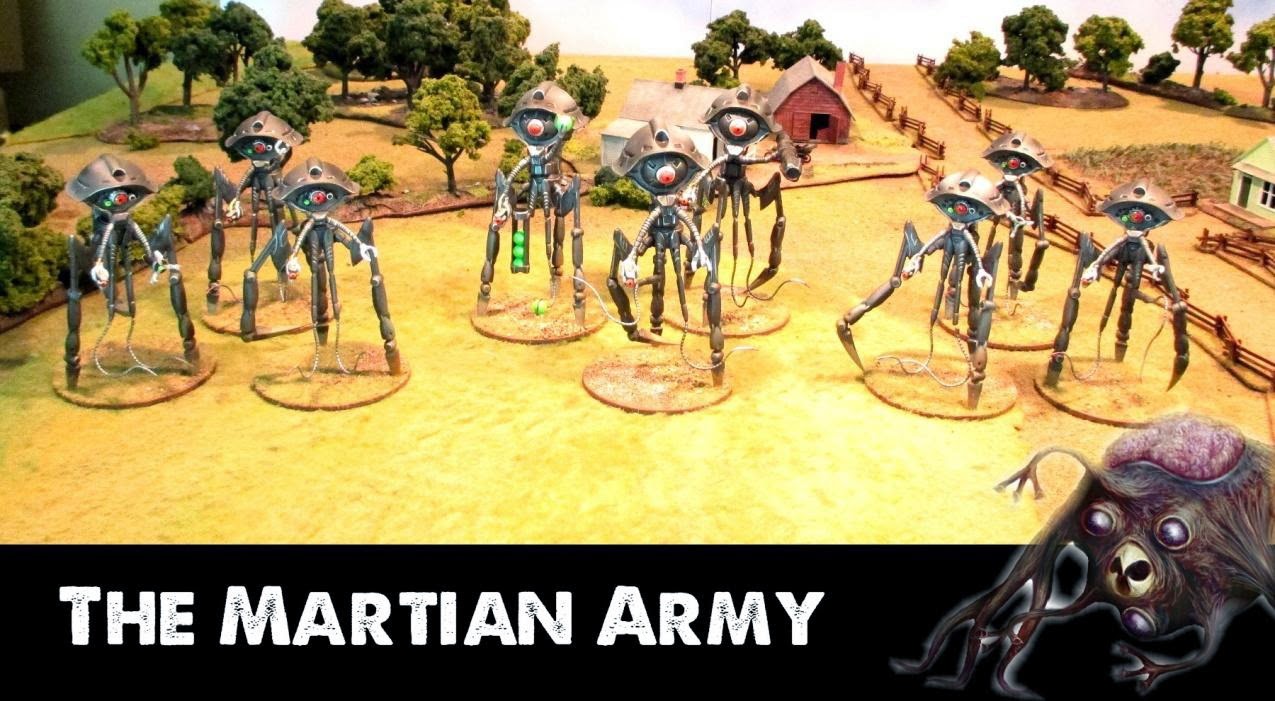
The possibilities of a second Martian invasion, probably taking place around the time of World War I. Assuming (over optimistically) that the Martians are able to fortify themselves against Earth's germs, that still leaves them with the element of surprise shot, and up against an enemy that now has poison gases of their own (chlorine, phosgene, and mustard), gas masks and protective clothing, Fighting-Machines of their own (tanks and armored cars), several flavors of flying machine (airplanes and zeppelins), long-range and quick-firing artillery pieces, recoilless guns, submarines, and all-big gun (Dreadnought-type) battleships.

The biggest handicap the Martians will face is that it takes many hours to break out of their cylinders, during which time humans can blast them with explosives of some sort. They could also position a cannon or machine gun right in front of the screw, to fire directly into the cylinder as soon as the screw falls out and slaughter the occupants. About the only thing the Martians could do is land in the most out-of-the-way places they can find, hoping that the human defenders won't have time to reach and attack the cylinders before they are opened. But under the new conditions, the humans have bombing aircraft to quickly attack the invaders wherever they land, and until the cylinders are opened, their occupants can't even shoot back. Landing on small, distant islands also leaves them vulnerable to fire from naval artillery.

It's believable that the second wave would be more heavily equipped than the first, given that those planning the invasion would have expected the first wave to establish a beachhead in England that would then be reinforced with further supplies and personnel. Possibly more powerful fighting machines, and construction tools to allow for setting up a long-term base on Earth.

You could have an ongoing battle starting up between the Martian Second wave, and the rest of the world's nations (United against this new threat) all in a WWI-esque setting. Humans would have advanced enough to put up more of a fight against the original book Martians, (Gas masks, howitzers, machine guns, land mines, rifle grenades, biplanes, ect. ect.) and we can see huge land/sea/air battles between the desperate humans and the entrenched Martian foes.

They'd need to land in a rather remote and isolated area to avoid being blown up before they're ready to move.

The Black Smoke poison gas the Martians use is a simple asphyxiating agent, so ordinary gas masks are sufficient protection against it. This takes away the Martians' biggest advantage, as the Black Smoke was more decisive than the Heat-Ray in their campaign of conquest. Against hidden and entrenched artillery, the Martians now have no choice but to advance into the humans' line of fire and take their licks until they can bring their Heat-Rays to bear.

We know absolutely nothing about the flying machine the Martians have, including its speed, range, and whether or not it is armed. If the Martians don't expect aerial opposition, they might content themselves with a relatively slow device that Earth's biplane fighters could successfully engage. (Remember, Mars is running low on resources, so they'd probably scrimp on their war preparations whenever they think they can safely get away with it.) Antiaircraft guns will also be a factor now, when the flying machine attacks cities and ground forces.

Some say that the Martians learned their lesson about engaging warships with the "Thunder Child" incident, and thus would now automatically fire on all warships at long range. But maybe they DIDN'T learn their lesson. The third Fighting-Machine had disappeared by the time the smoke cleared, so we don't know whether it walked away or got caught in the blast radius of the Thunder Child. Add to that the fact that the flying machine only turned up AFTER the battle, and we can see that the Martians might not have had any witnesses to tell them what happened.

It may not matter, anyway. The Thunder Child steamed in close before firing to presumably make every shot count, but with battleship-sized guns, she could also have fired on the Martians from miles away. And here's another thing to remember: pre-dreadnought battleships had only two to four battleship-sized guns, while carrying large numbers of smaller guns of various calibers. Capital ships of the Dreadnought era carried anywhere from eight to ten or even twelve guns of the largest type, relying almost entirely upon them during combat. That means that they would be far better suited to a long-range duel with the Fighting-Machines than the Thunder Child and her contemporaries were.

Physics doesn't always favor the technologically-advanced, either. Energy beams like the Heat-Ray have a major weakness against projectile-firing weapons of older type: they can only fire straight ahead. Indirect fire is impossible to them; a beam of light will only bend if it is near a black hole, and if the Martians wind up near one of THOSE, human weapons will be the least of their worries. Mortars, heavy artillery and howitzers, naval gunfire, and even (against personnel caught outside of their machines) bows, javelins, and slings can all be used to lob lethal fire at unseen targets.

Finally, if the Martians hang around near coastal regions or near large rivers, submarines could give them fits. The subs could sneak in underwater, possibly at night, surface, and feed the Martians a few shells from their deck guns before they even know they're around, then submerge and sneak away when the alarm is sounded.

War Between Worlds - Preview a Scenario from Alien Invasion

Tim Cox on a Scenario from Alien Invasion
As with the two previous books in The End of the World series, working on the new scenarios for the Alien Invasion book was a great experience that promised a wealth of variety. Each of the five scenarios presents a totally different take on the premise of an extraterrestrial attack. There are a lot of planets across the galaxy, after all. With such a diversity of potential alien types and invasion methods, it’s impossible for me to pick a favorite scenario. That would be like comparing giant ants and shape-shifting reptilians (not to put too fine a point on it). Still, at the risk of offending our future or secret alien overlords, I’ve always found the War Between Worlds scenario to be particularly fun.

At the onset of this scenario, Earth becomes the target of a sudden attack by, surprisingly enough, the Martians. Thanks in part to a considerable language barrier, the reasons for the invasion and the aliens’ intentions are an utter mystery. Yet the appearance of the aliens and their craft are also bewilderingly familiar. Out of all the scenarios in Alien Invasion, this is the one that likely offers the most instantly recognizable antagonists.

 War Between Worlds includes a number of elements that you’re sure to find familiar. Small Grey aliens, flying saucers, abductions, and ray guns have been staples of science fiction and Hollywood movies for decades. As the Player Characters will discover in the most unpleasant way, these concepts are so persistently popular because they’re all based in truth. That these tropes are so familiar, even cliché, makes the revelation of their reality even more shocking. Fleeing from a Grey armed with a heat ray might be an almost surreal experience for PCs. Plus, I’m quite amused by the idea of a terrifying sprint away from something you might have found comical on paper.

In actuality, there is certainly a fair degree of comic absurdity in an invasion of chrome saucers and Martians straight out of a 1950s comic book. The dichotomy between this almost laughable situation and the horror of your hometown suffering rampant destruction by the Martians should make for some interesting and memorable gaming moments. Fittingly, there’s a noticeable undercurrent of dark humor that runs through the whole scenario, which Game Masters can, of course, play up or down as fits their game and their group.

PCs are likely to recognize many aspects of the Greys, including their technology and their behavior, from pop culture books and movies—not that this familiarity is very comforting in the midst of a destructive alien invasion. Still, some PCs might find their knowledge of UFO lore and sci-fi films coming in handy as they struggle to survive the Martian attack. Of course, this lack of distinction between character knowledge and player knowledge is one of the great things that sets The End of the World roleplaying game line apart from other RPGs. If a player knows something (or thinks he knows something) about the threat the PCs are facing in the game, he is encouraged to make full use of this knowledge. Whether or not his knowledge turns out to be accurate is another matter entirely.

On the surface, War Between Worlds seems like a fairly simple scenario, and in some ways this is true. The Greys, hailing from Mars, launch an all-out attack on Earth without warning. It is, perhaps, the classic alien invasion. Flying saucers destroy monuments and abduct hapless citizens, while heat rays and atomizing beams decimate our military defenses. However, any PCs who survive long enough might learn some surprising truths behind the Greys’ aggression, and those who live into the post-apocalypse will—spoiler alert—encounter an even more dangerous enemy.

War Between Worlds offers you and your friends the chance to experience a familiar situation and threat from an entirely new perspective. Whether you’re able to find some grim humor in the nature of the alien threat or react with sheer horror to the rampant destruction, I hope you all—players and GMs—enjoy the scenario as much as I did.

Thursday, March 24, 2016

Inner Earth - Hollow Earth


Hollow Earth Expedition Earth Drill
Fat Dragon Games is proud to present our first official Hollow Earth Expedition model set, the Earth Drill. This model measures 11″ long and features fully rendered surface detailing, realistic tread and drill assemblies with all art in full color and 300dpi for maximum detail. This is a must have for any serious Hollow Earth Expedition fan (how else are you going to get to the Hollow Earth?)

The role playing game Hollow Earth Expedition features a fictionalized Thule Society's attempts at infiltrating the Hollow Earth. The source-book, Secrets of the Surface World, further expands the efforts of Nazis to discover and use occult relics.

Explore one of the world’s greatest and most dangerous secrets: the Hollow Earth, a savage land filled with dinosaurs, lost civilizations, and ferocious savages! Players take on the roles of two-fisted adventurers, eager academics and intrepid journalists investigating the mysteries of the Hollow Earth. Meanwhile, on the surface, world powers and secret societies vie for control of what may be the most important discovery in all of human history.

Set in the tense and tumultuous 1930s, the action-filled Hollow Earth Expedition is inspired by the literary works of genre giants Edgar Rice Burroughs, Jules Verne, and Sir Arthur Conan Doyle. The subterranean action is powered by Ubiquity, an innovative roleplaying system that emphasizes storytelling and cinematic action.


Hollow Earth
Edmund Halley (1656-1742) is best known for having calculated the orbit of a comet that passes by Earth every 76 years. The comet known as Halley's made its first appearance under that name in 1682. During the next decade, Halley turned his attention away from the celestial in favor of the subterranean. He claimed that the Earth was hollow and populated by humans and beasts. 

Halley's Hollow Earth idea was developed further during the eighteenth and nineteenth centuries, and sometimes backed by sound scientific reasoning. None of the claims of Hollow Earth proponents have been substantiated, however. Those still holding to the belief in the twenty-first century are part of a long history of people who believe human life exists beneath the surface of the Earth.

Halley's theory was based on the fact that the earth's magnetic field varies over time. Halley suggested that there were several magnetic fields, one of which emanated from a sphere within the earth. Halley eventually developed the idea that there were four con- centric hollow spheres within the earth. He believed the inner earth was populated with life and had a luminous atmosphere. The aurora borealis, he concluded, was actually an emanation of radiant gases from within the earth that escaped through thin layers of crust at the poles.

During the eighteenth century, Halley's Hollow Earth theory was adapted by two other famed mathematicians, Leonhard Euler (1707-1783), a Swiss, and John Leslie (1766- 1832), a Scotsman. 
Euler abandoned Halley's concentric spheres idea. He postulated that a glowing core some six hundred miles wide warmed and illuminated the inner earth, where an advanced population thrived. Leslie, on the other hand, believed there were two concentric spheres within the earth each with their own sun, which he named Pluto and Proserpine after the Greek god of the under- world and his mate.

Perhaps the most enthusiastic proponent of the Hollow Earth idea was John Cleves Symmes, who was born in 1780 in New Jersey. He was named after an uncle who fought in the American Revolutionary War. Symmes fought in the War of 1812, after which he moved to St. Louis, Missouri, and established a trading post. He immersed himself in read- ing books in the natural sciences. By 1818 he was publicizing his version of the Hollow Earth, which had concentric spheres and received light and warmth from the sun through large holes in the planet open at each of the poles. 

Symmes proved relentless in publicizing his views: he was a prolific lecturer and writer of letters and articles; wrote fictional accounts of the Hollow Earth, including Symzonia: Voyage of Discovery (1820), which he published under the pseudonym Adam Seaborn; and advocated expeditions to the poles. His Hollow Earth illuminated by openings at the poles became the most popularly known version, and one that would be tested as humans began struggling to reach the poles. 

Symmes was able to impress two influential men who would take his cause further. James McBride, a wealthy Ohio man, wrote articles supporting the concentric spheres version of the Hollow Earth. He lobbied a U. S. senator from Kentucky to support a bill fund- ing a proposed expedition to explore trade routes in the southern hemisphere (where McBride hoped the expedition would continue on to the open pole). The senator he had lobbied, Richard M. Johnson (1790-1850), later became vice president of the United States under Martin Van Buren (1782-1862). In 1828, President John Quincy Adams (1767-1848) indicated that he would approve funding for the expedition. However, when Adams left office in 1829, his successor, Andrew Jackson (1767-1845), stifled a bill funding the proposed expedition. 

Symmes died in 1829, but his cause was continued by Jeremiah Reynolds, an Ohio newspaper editor. After the failure to get government funding for the expedition in 1829, Reynolds joined a crew sailing to the south seas to hunts seals, but seven years later in 1836, he helped renew efforts for funding of a Southern Hemisphere expedition. Reynolds spoke before Congress, emphasizing the national glory that would accompany scientific discoveries and expanded foreign relations, but he became so impatient with the methodical planning and a series of delays that he was fired from the crew.
What became known as the Wilkes expedition, named after its commander, Charles Wilkes (1798-1877), launched in 1838. When the expedition was completed in 1842, they had effectively mapped a landmass where Symmes had envisioned a large hole in the earth. The world's seventh continent, Antarctica, was officially recognized for the first time. 

The open poles theory promoted by Symmes had been effectively undermined, but the belief in the Hollow Earth would only grow more popular. In 1846, the remains of a woolly mammoth, a creature long extinct, were discovered perfectly preserved in ice in Siberia. So suddenly had it been frozen, that the mammoth had not yet digested pine cones it had recently eaten. It was theorized that the animal had been caught by a climate change, but many questioned that such a change could have happened so quickly and thoroughly. Some people believed the animal had wandered out from the Hollow Earth through a hole at the North Pole. 

As late as 1913, even after the North Pole had been reached, Marshall Gardner published A Journey to the Earth's Interior, or Have the Poles Really Been Discovered? which claimed that many creatures thought to be extinct were still thriving within the earth. Gardner theorized that the interior earth was warmed by materials still spinning since earth's creation. Based on the law of centrifugal force, Gardner argued that earth was originally a spinning mass of matter. An outer layer of matter had hardened and continued to revolve around a central axis, while an inner layer also hardened and was warmed by heat continually generated by the earth's spinning. 

That same year, William Reed published The Phantom of the Poles (1906), in which he promoted the idea that a ship can pass from outer Earth to inner Earth. The effect of gravity pulls a ship against the interior in the same manner as it works on the exterior. He claimed that some sailors had already passed into inner Earth without knowing it. Gravity had pulled them to the interior side, where a 600 mile-long sun continued to keep them warm, as the outer sun had done.

In between the woolly mammoth find and those publications of 1913, fascination in the Hollow Earth was exhibited by scientists and science fiction writers. Jules Verne (1828- 1905) published Journey to the Center of the Earth (1864), in which characters enter the Earth's interior through the chimney of an inactive volcano in Iceland. In 1873, The Coming Race, a novel by the occultist Edward Bulwer-Lytton (1831-1891), was set in the Earth's interior, where an advanced civilization of giants thrived. In this story, the giants had built a paradise and discovered a form of energy so powerful that they outlawed its use as a potential weapon. The paradise is threatened, nevertheless; not by weapons, but by a lack of conflict that has resulted in general boredom. 

One of the more interesting variations on the Hollow Earth theory during the late nineteenth century was expounded by Cyrus Read Teed (1830-1908). In The Cellular Cosmogony, or The Earth, A Concave Sphere, Teed claimed a civilization inhabited the concave inner surface of Earth. Dense atmosphere pre- vents viewing across the surface. The Moon, according to Teed, reflects the larger, uninhabitable surface of Earth. 

Teed made a religion of his discoveries and changed his name to Koresh, the Hebrew equivalent of his given name, Cyrus. As the messiah of Koreshanity, he formed a church, started a magazine, The Flaming Cross, which continued to be published regularly into the 1940s, and founded a community on a 300-acre tract in Florida in 1894. He lived there with about 250 followers until 1908. Upon his death, his followers waited for him to rise again, as he had prophesied. After four days, health officials appeared on the scene and ordered his burial. 

Hollow Earth theories continued to be promoted by enthusiasts even as explorers reached the North and South Poles during the first decade of the twentieth century. The open poles theory was further undermined when aviator Richard E. Byrd (1888-1957) became the first to fly over the North Pole (1926) and the South Pole (1929) and reported nothing but unending whiteness. In 1959, a U. S. submarine journeyed beneath the polar ice cap and actually surfaced at the North Pole, based on precise calculations. Since then, year-round research stations have been built on several sites at both poles. No large holes have been found. 

Hollow Earth enthusiasts continue to believe. Teed's Concave Earth theory, for example, was tested during World War II (1939-1945) by a Nazi scientist. He aimed a camera at a 45-degree angle into the sky from an island in the Baltic Sea, hoping to catch an image of a British fleet on the other side of the concave Earth. The experiment was unsuccessful.

Delving Deeper Beckley, Timothy Green, ed. The Smoky God and Other Inner Earth Mysteries. New Brunwick, N. J.: Inner Light Publications, 1993. Bernard, Raymond. The Hollow Earth. Mokelumne Hill, Calif.: Health Research, 1963. Gordon, Stuart. The Encyclopedia of Myths and Leg- ends. London: Headline Books, 1993. Michell, John. Eccentric Lives and Peculiar Notions. San Diego, Calif.: Harcourt Brace Jovanovich, 1984.